
We are a collective of Intellectual Property experts.
Through robust team collaboration, we provide
powerful support for your company’s IP strategy.
Patent, design, utility model and trademark applications are the backbone of our firm.
We believe we can provide faster, more efficient and higher quality application services
for our international clients than most other firms because we do nearly all of our translations in-house.
Prosecution
Our ability to quickly translate our foreign clients’ amendments into Japanese, as well as our ability to translate office actions from Japanese quickly and concisely allows us to deal with prosecution matters better than most Japanese firms.
Annuity payments・Renewals
Our firm is also equipped to make the annuity payments on patents, utility models and designs. We routinely notify our foreign clients well before payment deadlines, and send reminders as necessary to avoid oversights.
Similarly, for trademark registrations we notify our clients before the renewal period begins, and send reminders to ensure that a registration does not unintentionally lapse.
Searches
Virtually all of our searches are handled in-house, to ensure client confidentiality. We employ state-of-the-art computers that link our office to the patent and trademark data distribution system, which provides quick and reliable access to documents published by the government. Our firm has access to search databases. Certified professional searchers handle all searches for our foreign clients.
Applications
Patent, design, utility model and trademark applications are the backbone of our firm. We believe we can provide faster, more efficient and higher quality application services for our international clients than most other firms because we do nearly all of our translations in-house.
Fees
We offer standard flat rate fees for services, allowing our clients to plan their budgets for intellectual property protection. Our location in Gifu, one of the main industrial corridors of Japan, allows our firm to offer reasonable fees.
Communication
We take pride in our unparalleled speed in responding to customer inquiries. Typically, we respond within one or two business days of receiving your inquiry.
In certain regions of Asia and Oceania, it is customary to respond to inquiries received in the morning before the end of the business day.
You can contact us via “CONTACT”.

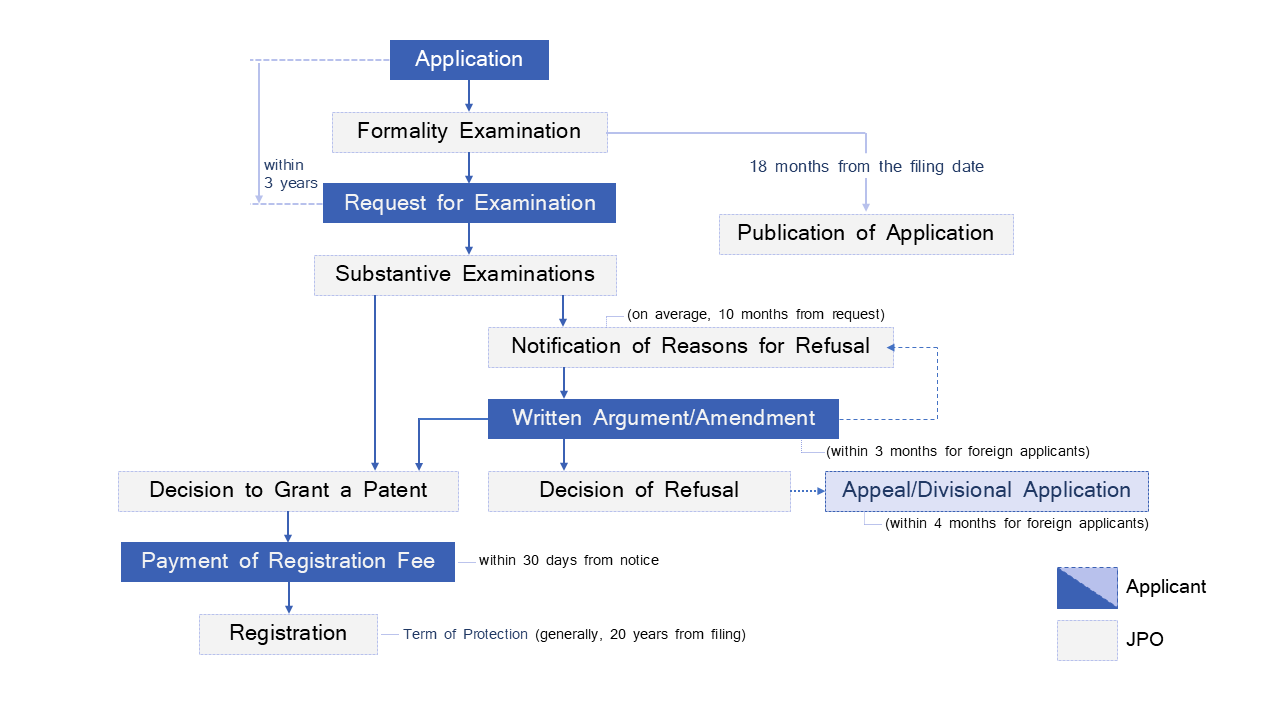
Procedures for Obtaining a Patent Right
| Filing Routes in Japan |
There are two primary methods for filing a Japanese patent application.
|
| Necessary Documents and Information |
■Patent Application:
-Direct filing:
Additional requirements are as follows:
*There is also a system for foreign language written applications where the specification, claims, necessary drawings, and abstract can be submitted in English or other foreign languages. ■National Phase Entry into Japan (PCT Route):National phase application must be filed within 30 months from the priority date.
In the case of non-publication;
|
| Translation |
A special period for submitting translations exists under certain conditions Foreign Language Written Applications:The Japanese translation of a foreign language written applications must be submitted within 16 months from the earliest priority date or filing date. However, if a divisional or conversion application is filed based on a foreign language written application, the translation may be submitted within two months from the new filing date. National Phase Entry of the PCTTranslations during National Phase application must be submitted within the National Phase application filing period (within 30 months from the priority date). However, if the National Phase application is filed between the second month prior to the expiration of the National Phase application filing period and the expiration date, the translation may be submitted within two months from the date of filing the National Phase application. |
| Overview of the Patent Process after Filing |
Formality Examination
Upon filing, the JPO assigns an application number and conducts a formality examination. If any formal deficiencies are found, the JPO will issue an “Invitation to Correct” (Order for Amendment), and the applicant must rectify the defects within a specified time limit. Publication of ApplicationA patent application is published in the Official Gazette after 18 months have passed from the earliest priority date. The applicant may also request early publication of the application. Substantive examination is initiated only upon the filing of a Request for Examination. Currently, the first office action is issued, on average, 10 months after the request is filed.
Voluntary Amendments
Substantive Examinations (Application Prosecution)
Applicants may voluntarily amend the claims, specification, and/or drawings at any time prior to receiving the first Office Action. For applications meeting certain requirements, expedited examination is available through systems such as Accelerated Examination, Super-Accelerated Examination, and the Patent Prosecution Highway (PPH). These programs significantly shorten the period until the first Office Action. Substantive examinations are conducted in accordance with the Examination Guidelines for Patent. The main requirements for patentability subject to examination are as follows.
Patentability Requirements
If the examiner finds reasons for refusal, a Notice of Reasons for Refusal (Office Action) will be sent to the applicant. If the applicant receives the notification, written argument and/or amendments must be submitted within the designated time limit (3 months for foreign applicants). This period can be extended by up to 3 additional months upon filing a request and paying the required fees. Final Decision Decision of Patent GrantIf the examination finds no reasons for refusal, or if the reasons for refusal were resolved by written argument and/or amendments, a Decision of Patent Grant will be made. In order to have the patent registered, the required registration fees (the first to third years) must be paid within 30 days from the date of receipt of the Allowance Notice from JPO. Certificate of Patent will be issued accordingly. If the reasons for refusal were not eliminated, a Decision of Rejection will be made.
1. Appeal against Decision of Rejection
An appeal against the decision of rejection may be filed within four months from the date of service of the certified copy of the decision of rejection. An amendment may be filed at the same time. This period is not extendable. A divisional application may be filed within four months from the date of service of the certified copy of the decision of rejection. The application may be converted into a utility model application or a design application. |
| Annuity Payment |
To maintain the patent right, the patent fee (annuity fee) must be paid every year. |
| Duration |
The patent term is 25 years from the filing date. |
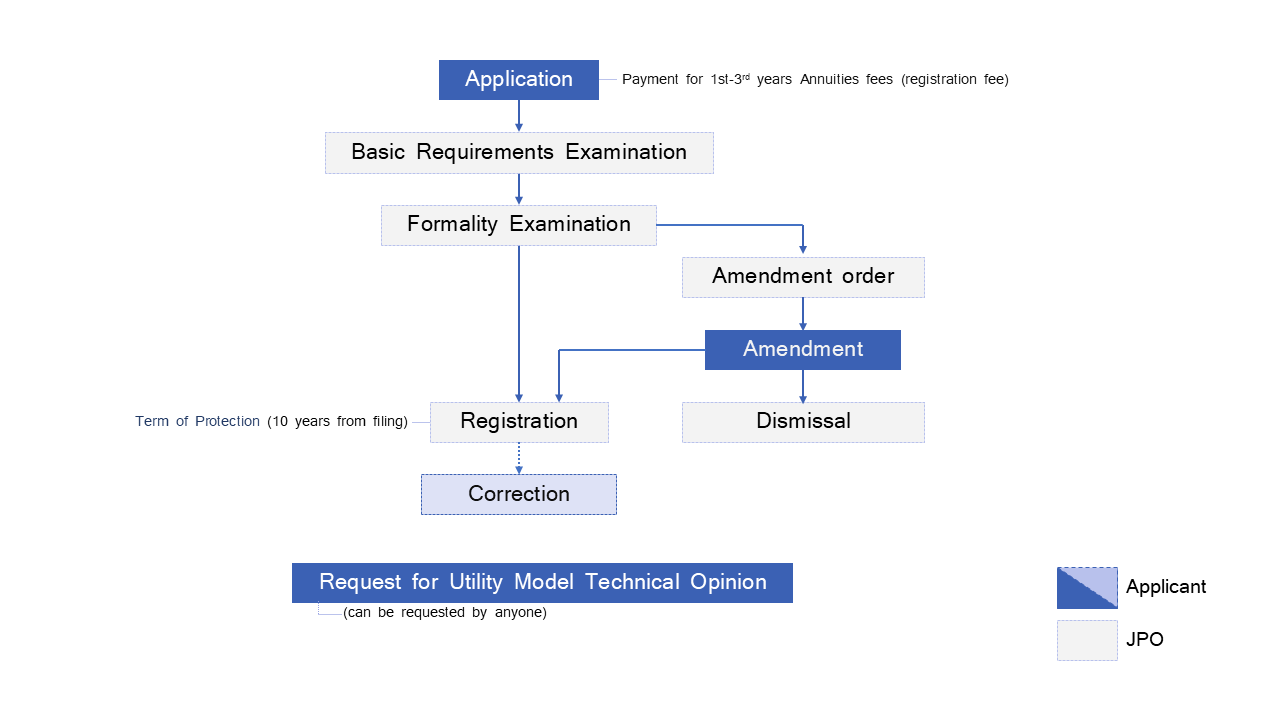
Procedures for Obtaining a Utility Model Right
| Necessary Documents and Information |
■Utility Model Application:
-Direct filing:
Additional requirements are as follows:
Similar to patents, National phase application is possible based on an international application under the Patent Cooperation Treaty (PCT). |
| Differences from Patents | *Payment of 1 to 3 years’ worth of annual fees is required at the time of filing. |
| Conversion of Application | A patent application may be converted to a utility model application or a design application. |
| Duration |
The term of the utility model right is 25 years from the filing date. |
Procedures for Obtaining a Trademark Right in Japan
| Filing Routes in Japan |
There are three primary methods for filing a Japanese Trademark application:
|
| Necessary Documents and Information |
Trademark Application:
-Direct filing
Additional requirements are as follows:
|
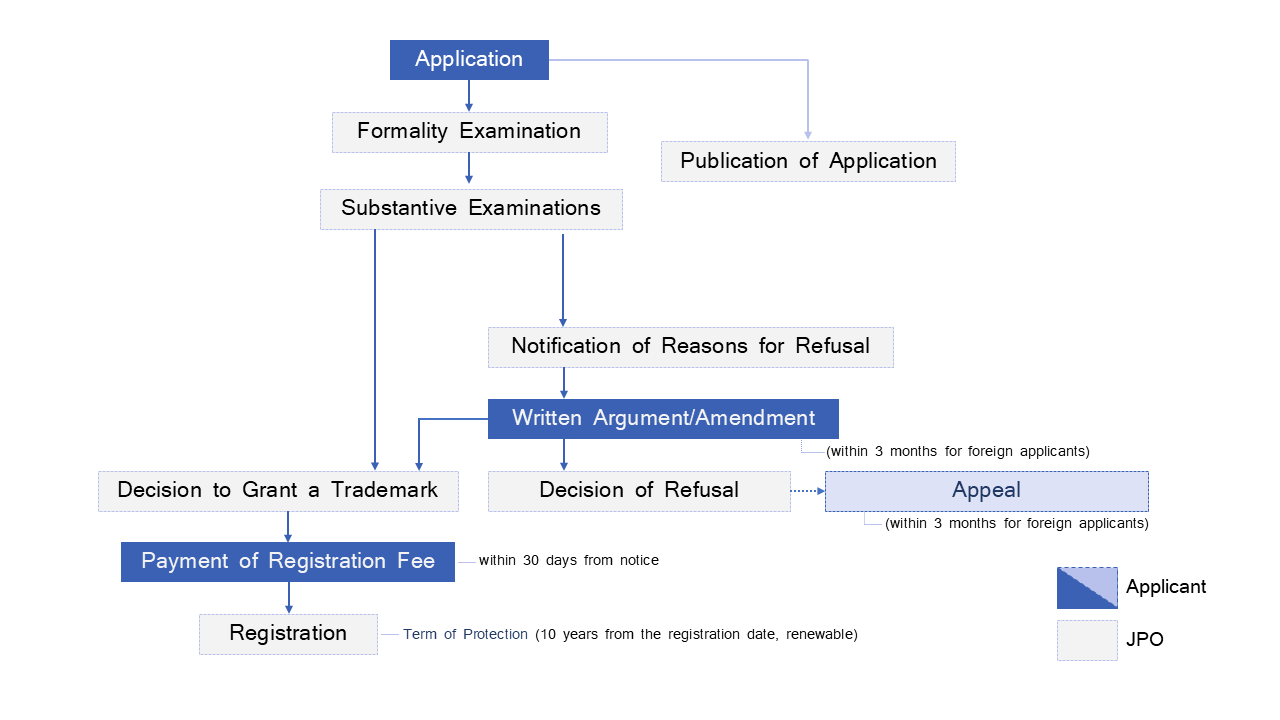
| Overview of the Process after Filing |
Formality Examination:
The JPO assigns an application number and checks formal requirements.
If a trademark is well-known, it is possible to file an application designating dissimilar goods or services as a defensive trademark. Publication of ApplicationThe content of an application will be published in the Official Gazette by the JPO after filing. Substantive Examination:All trademark applications are subject to substantive examination without a request for examination. If it is ultimately judged that there are no reasons for refusal, a decision to register a trademark will be issued. If a written argument and an amendment can not eliminate the reasons for refusal, and if the examiner judges that the trademark can not be registered, a decision of refusal will be made. An appeal against the decision of rejection may be filed within three months of the date of service of the certified copy of the decision of rejection. This period is not extendable. |
| Renewal |
Renewal fees can be paid in two 5-year installments instead of a full 10-year lump sum (this option is not available for protective trademarks). |
| Duration |
10 years from the date of registration, renewable every 10 years. |
| Precautions |
Cancellation Trial based on Non-Use
A registered trademark is subject to a Non-Use Cancellation Trial if it has not been used in Japan for three consecutive years. |
Procedures for Obtaining a Design Right in Japan
| Filing Routes in Japan |
There are two primary methods for filing a Japanese design application:
|
| Necessary Documents and Information |
Design Application:
-Direct filing
Additional requirements are as follows:
|
| Design Systems in Japan |
Related Design System:
An applicant can register designs that are similar to their own previously filed or registered design (Principal Design). An international design application can be designated as a principal design. Secret Design System:An applicant may request that the design be kept confidential for a period of up to 3 years from the date of registration. |
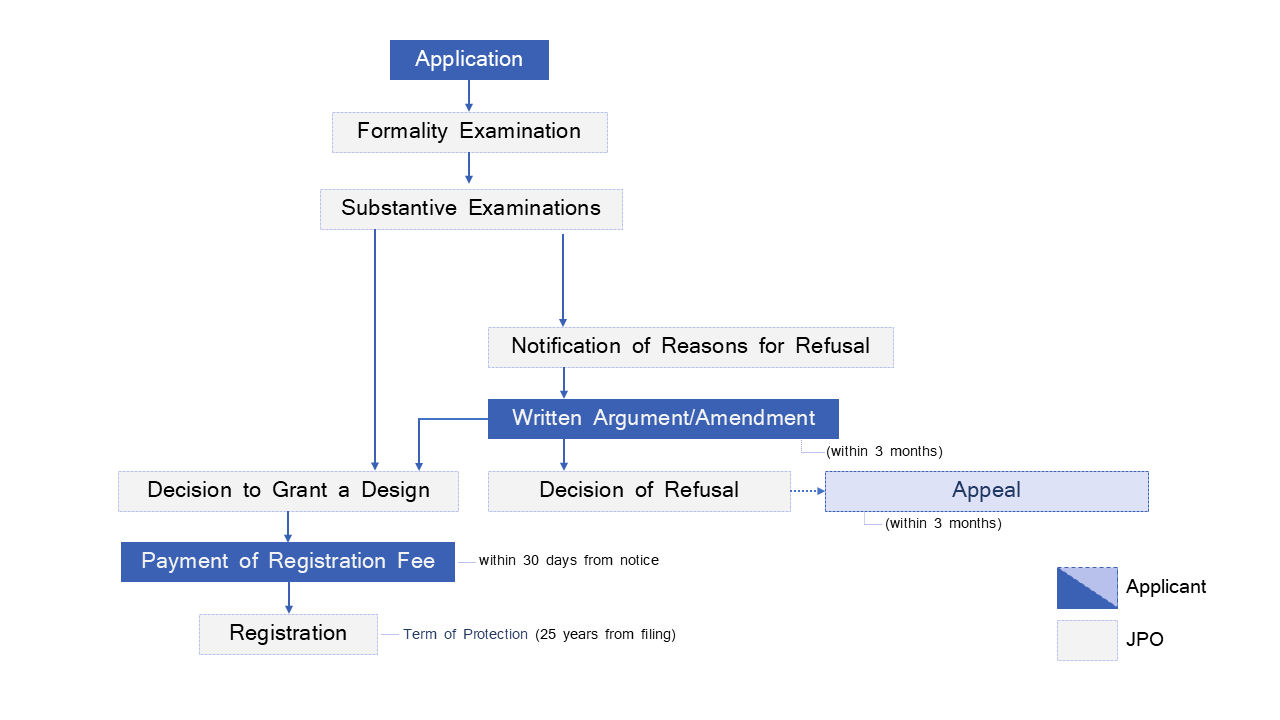
| Overview of the Process after Filing |
Substantive Examination:
All design applications are subject to substantive examination without a request for examination.
Requirements for Registration
If the examiner finds reasons for refusal, a Notice of Reasons for Refusal (Office Action) will be issued. If the examination finds no reasons for refusal, or if the reasons for refusal are overcome by written argument and/or amendments, the JPO will issue a Decision of Registration. In order to have the design registered, the required registration fees (the first year) must be paid within 30 days from the date of receipt of the Decision of Registration. A certificate of Design Registration will be issued accordingly. However, there are no provisions regarding the reduction, exemption, or deferral of registration fees, as is the case with patents and utility model registrations. Decision of RejectionIf the reasons for refusal are not overcome, a Decision of Rejection will be issued.
1. Appeal against Decision of Rejection
An appeal against the decision of rejection may be filed within three months from the date of service of the certified copy of the decision of rejection. This period is not extendable. The application may be converted into a patent application within 3 years of the filing date or into a utility model application within 9 years and 6 months of the filing date. |
| Annuity Payment |
To maintain the Design right, the design fee (annuity fee) must be paid every year. If the payment due date is missed, the right can still be maintained by paying twice the normal fee within a six-month grace period. If unpaid after the grace period, the right lapses. |
| Duration |
A design right expires 25* years from the filing date**. In the case of a Related Design, the design right expires 25 years from the filing date of its Principal Design application. |
| Precautions |
– Procedures for Exception to Loss of Novelty in International Design Applications (Hague Applications)
An international design registration application must be filed with WIPO within one year of the publication resulting from the applicant’s own disclosure. If the application filed with WIPO does not include a request for the exception to loss of novelty, the applicant may, within 30 days of the date of publication of the international registration in Japan, submit to the Japan Patent Office a written request for the exception to loss of novelty, along with documentation proving the fact of publication. – Registration of Design Rights for International Design Applications (Hague Applications)For international design registrations, the design right is registered without payment of a registration fee. |
Power of Attorney
The JPO does not require a Power of Attorney for basic filings of patents, utility models, designs, or trademarks. However, it is highly recommended to submit an executed Power of Attorney in case it becomes necessary at a later stage, such as when filing an appeal against a rejection, when withdrawing or abandoning an application, or other specialized procedures.
We recommend that the applicant sign the General Power of Attorney form. This single form will cover not only the current matter but also any other new matters that might arise in the future. Consequently, should new matters arise, we could then represent the applicant in connection with those matters without the need for an additional Power of Attorney.
If the applicant prefers, for any reason, to limit the scope of our power to the current matter, the applicant may do so by signing and returning the Specific Power of Attorney form.
You can use either of the following forms and have it executed by the applicant and return a scanned copy to us by email (PDF):
Download: General Power of Attorney form (PDF)
Download: Specific Power of Attorney form (PDF)